Essent

About

Essent is a neo-grotesque sans serif that brings a subtle human touch and quiet warmth to the clarity and neutrality of the genre. Designed for running text and everyday typography, it keeps the practicality of neo-grotesque sans serifs while allowing for a softer, more natural feel in text. Its stroke-end cuts follow the direction of the strokes, softening the family’s overall feel without interrupting its neutral tone.

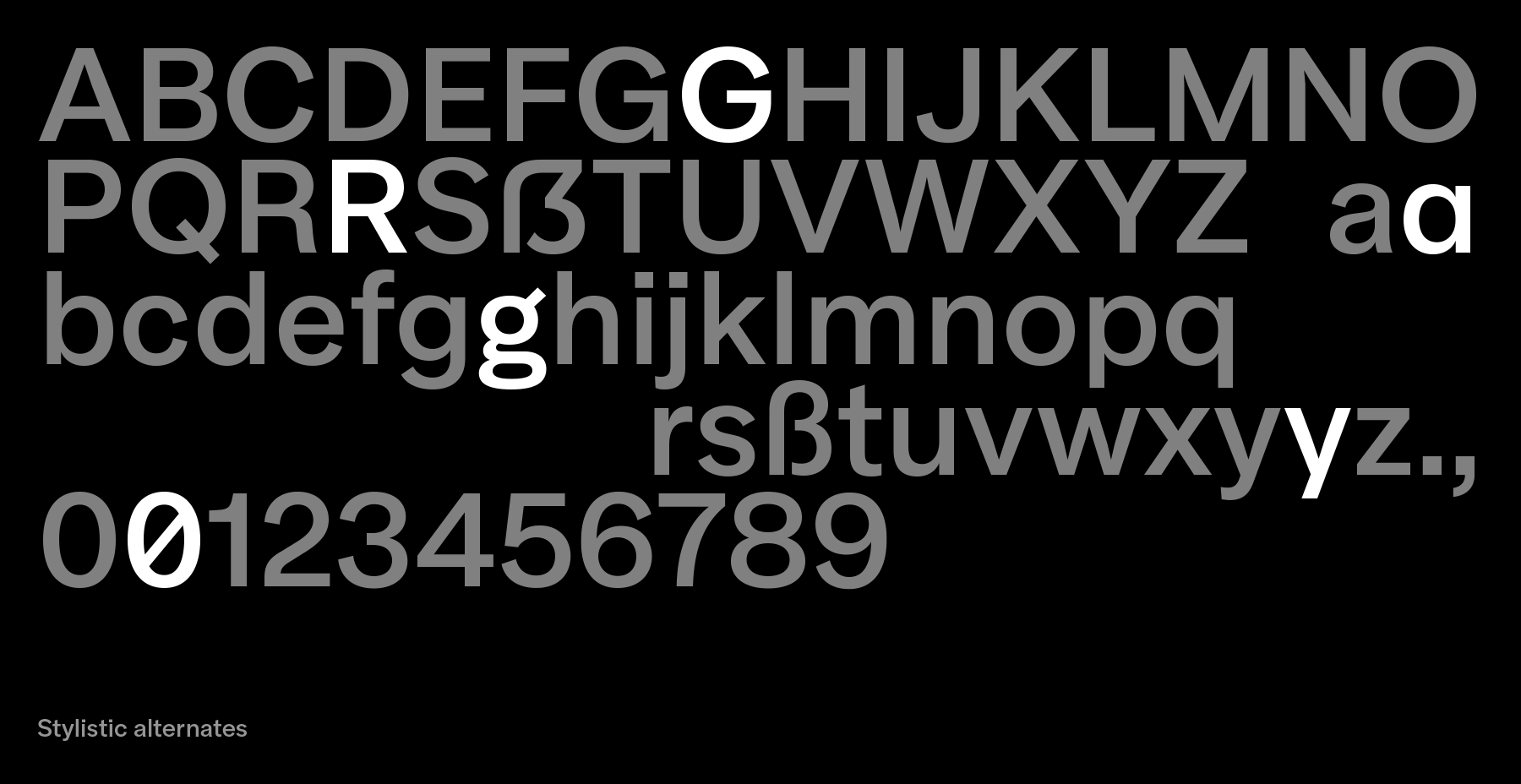
Originally developed as Typeji’s own system typeface, Essent began under the working name Typeji Neue. Made for the studio’s website, documents, and daily use, it grew into a family of eight weights with corresponding italics and a broad set of useful features. These include stylistic alternates for G, R, a, g, and y, allowing for subtle shifts in tone, as well as a wide range of arrows and geometric shapes. These supporting characters give designers more ways to structure information and add visual variety within a layout. The family also offers broad language support across the Latin script.

Essent was shaped by the same everyday contexts it was made for: text, editorial layouts, documents, and other forms of daily design work. The name Essent reflects that everyday role.

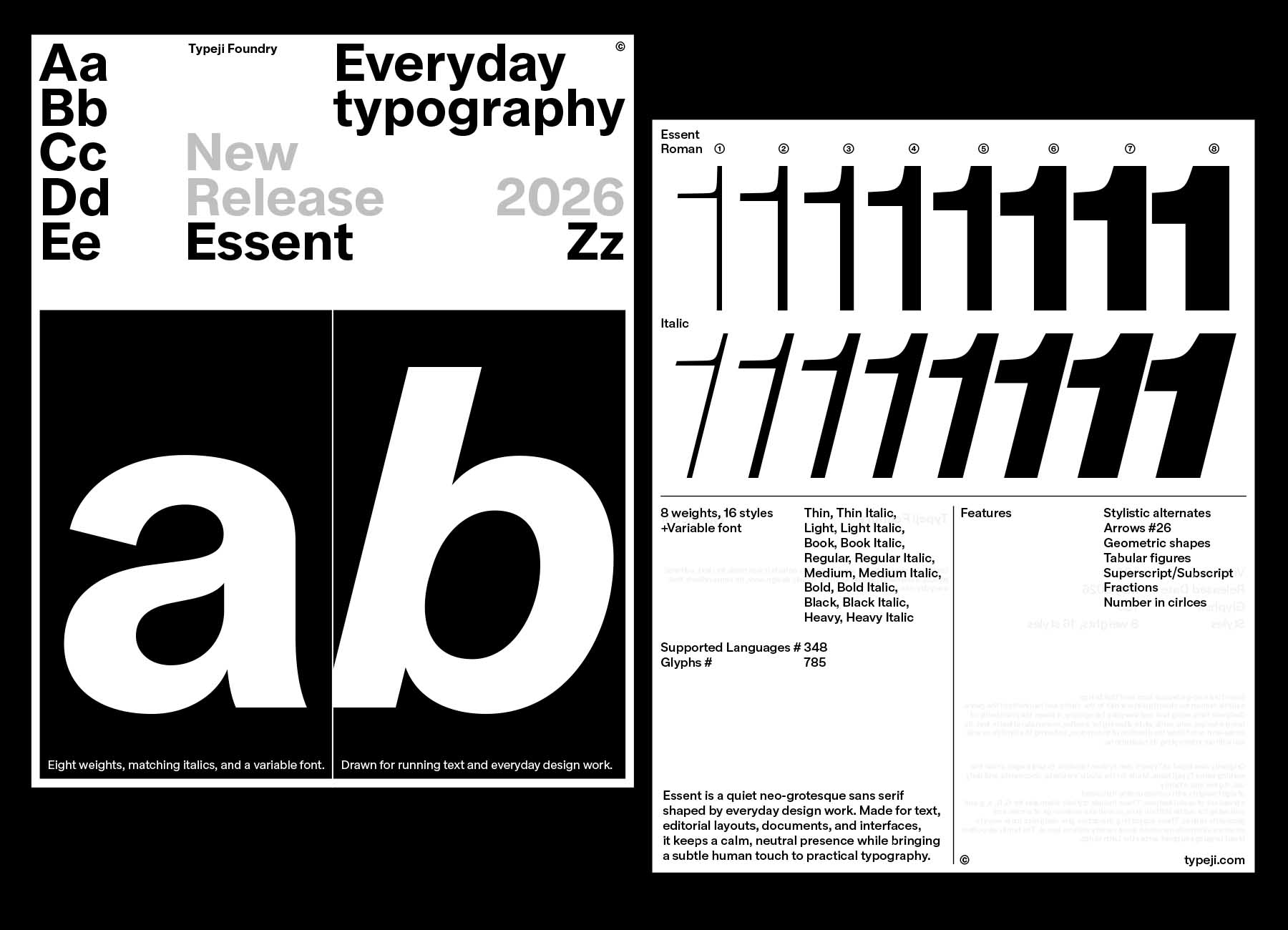
16 styles

  • Thin, Thin Italic
  • Light, Light Italic
  • Book, Book Italic
  • Regular, Regular Italic
  • Medium, Medium Italic
  • Bold, Bold Italic
  • Black, Black Italic
  • Heavy, Heavy Italic
Standard Issue®
Edition™
Object No.2
PROJECT®
Format 01

Essent Heavy

[WORDS IN PUBLIC SPACE] The exhibition examines how language enters public space through signs, tickets, maps, posters, receipts, and screens. Rather than treating text as a neutral carrier of information, the exhibition approaches it as a designed surface shaped by scale, sequence, and repetition. The works move through ❶ street signage, ❷ printed matter, and ❸ interface language, tracing how PUBLIC TEXT shifts from instruction to atmosphere, from function to form. What emerges is not only a history of style, but a study of how words organize attention [and sometimes authority] in everyday life. The exhibition brings together works by Marcus Müller (b. 1974, Köln), Sofia Lindén (b. 1984, Malmö), Élodie Martin (b. 1991, Lyon), and Akiko Nakamura (b. 1986, Tokyo). Müller is known for installations built from municipal lettering and found notices; Lindén works across editorial design and public information systems; Martin focuses on artists’ books, captions, and exhibition graphics; Nakamura develops text-based environments using arrows, symbols, and directional markers. Although their methods differ, each artist approaches text as both CONTENT and STRUCTURE, moving from poster → wall label → projection → archive file in a continuous chain of reading. Presented at Halle Nord [Zürich-West / Kreis 5], the exhibition runs from 14 May–30 August 2026 and is open Wed–Sun, 11:00–18:00 (last entry 17:30). A public talk takes place on 12 June at 18:30, followed by a district walk on 13 June [meeting point: Entrance B → Courtyard].
The accompanying booklet includes document facsimiles marked Draft¹, Revision², and Archive³, alongside notes on typographic hierarchy, scale shifts, and public notation. Admission is CHF 18 / CHF 12 reduced; visitors under 18 enter free. In keeping with the exhibition’s central idea, even its supporting materials—tickets, maps, labels, schedules—are treated not as background, but as part of the visual argument itself.

[ÖFFENTLICHE TEXTE] Die Ausstellung untersucht, wie Sprache über Schilder, Fahrkarten, Karten, Plakate, Belege und Bildschirme in den öffentlichen Raum eintritt. Anstatt Text als neutralen Träger von Information zu behandeln, versteht die Ausstellung ihn als gestaltete Oberfläche, die durch Maßstab, Abfolge und Wiederholung geprägt ist. Die Arbeiten bewegen sich durch ❶ Straßenbeschilderung, ❷ Drucksachen und ❸ Interfacesprache und zeichnen nach, wie sich ÖFFENTLICHER TEXT von Anweisung zu Atmosphäre, von Funktion zu Form verschiebt. Sichtbar wird dabei nicht nur eine Stilgeschichte, sondern auch eine Untersuchung darüber, wie Wörter im Alltag Aufmerksamkeit organisieren [und manchmal auch Autorität]. Die Ausstellung versammelt Arbeiten von Marcus Müller (geb. 1974, Köln), Sofia Lindén (geb. 1984, Malmö), Élodie Martin (geb. 1991, Lyon) und Akiko Nakamura (geb. 1986, Tokyo).
Müller ist für Installationen bekannt, die auf kommunalen Beschriftungen und gefundenen Hinweisen basieren; Lindén arbeitet an der Schnittstelle von Editorial Design und öffentlichen Informationssystemen; Martin konzentriert sich auf Künstlerbücher, Bildunterschriften und Ausstellungsgrafik; Nakamura entwickelt textbasierte Umgebungen mit Pfeilen, Symbolen und richtungsweisenden Markierungen. Trotz ihrer unterschiedlichen Methoden nähert sich jede der Künstler:innen Text zugleich als INHALT und STRUKTUR und verfolgt eine fortlaufende Kette des Lesens von Plakat → Wandetikett → Projektion → Archivakte. Präsentiert in der Halle Nord [Zürich-West / Kreis 5], läuft die Ausstellung vom 14. Mai bis 30. August 2026 und ist Mi–So von 11:00 bis 18:00 Uhr geöffnet (letzter Einlass 17:30). Ein öffentliches Gespräch findet am 12. Juni um 18:30 Uhr statt, gefolgt von einem Stadtteilrundgang am 13. Juni [Treffpunkt: Eingang B → Innenhof]. Das begleitende Heft enthält Dokumentfaksimiles mit den Markierungen Entwurf¹, Revision² und Archiv³ sowie Anmerkungen zu typografischer Hierarchie, Maßstabsverschiebungen und öffentlicher Notation. Der Eintritt beträgt CHF 18 / CHF 12 ermäßigt; Besucher:innen unter 18 Jahren haben freien Eintritt. Im Einklang mit der zentralen Idee der Ausstellung werden selbst ihre Begleitmaterialien — Fahrkarten, Karten, Etiketten, Zeitpläne — nicht als Hintergrund behandelt, sondern als Teil des visuellen Arguments selbst.
Neue Halle für
Gestaltung, Köln
◐∆
[Open File­–③]
“Layers of Reality”
Sören Lindqvist
Zürich-West/Kreis 5
Archive©2026
FORMEN FÜR DEN ALLTAG
Forms for Everyday Use
« DU GESTE AU SYSTÈME » Tout projet commence par une note rapide, une marque en marge ou un petit croquis [souvent inachevé]. Ce qui apparaît d’abord comme une intuition passe progressivement par une série de décisions : ① placement, ② proportion, ③ répétition. Une forme est mise à l’épreuve, ajustée, puis reprise (parfois plusieurs fois), jusqu’à tenir comme un SYSTÈME plutôt que comme un simple geste. Le passage du croquis à la STRUCTURE est rarement spectaculaire. Il s’opère par de petites corrections → une ligne devient plus stable, un espace plus clair, une relation plus précise. Ce qui compte n’est pas seulement la composition finale, mais aussi le chemin qu’elle emprunte : ○BROUILLON → ○ÉPREUVE → ◑RÉVISION → ●USAGE. Dans ce mouvement, le design cesse d’être uniquement une affaire d’expression pour devenir une manière de construire les conditions de la lecture, de l’ordre et de la continuité. Une affiche, une page ou un panneau peut encore porter les traces de son commencement [une hésitation, une version alternative, une note entre crochets], mais sa fonction se transforme à mesure que le travail se développe. Le projet passe de la possibilité à un cadre, d’un champ ouvert à une forme lisible. La structure n’efface pas le croquis ; elle lui donne une direction (et parfois de la retenue), afin que l’idée initiale puisse rester visible tout en devenant utilisable.
“FROM GESTURE TO SYSTEM” Every design begins with a loose note, a margin mark, or a small sketch [often unfinished]. What first appears as instinct gradually moves through a series of decisions: ① placement, ② proportion, ③ repetition. A form is tested, adjusted, and tested again (sometimes several times) until it begins to hold together as a SYSTEM rather than a gesture alone. The shift from sketch to STRUCTURE is rarely dramatic. It unfolds through small corrections → a line becomes steadier, a space becomes clearer, a relationship becomes more precise, and the overall composition begins to settle into place. What matters is not only the final result, but also the path it takes: ○DRAFT → ○PROOF → ◑REVISION → ●USE. In that movement, design becomes less about expression alone and more about building the conditions for reading, order, continuity, and repeated use. A poster, a page, or a sign may still carry traces of its beginning [a hesitation, an alternate version, a note in brackets], yet its role changes as it develops. The work moves from possibility to framework, from an open field of ideas to a readable and usable form. Structure does not erase the sketch; it gives it direction (and sometimes restraint), allowing the original idea to remain visible while gradually becoming clearer, steadier, and more fully resolved.
R1↳
23°C

Uppercase
  • A
  • B
  • C
  • D
  • E
  • F
  • G
  • H
  • I
  • J
  • K
  • L
  • M
  • N
  • O
  • P
  • Q
  • R
  • S
  • T
  • U
  • V
  • W
  • X
  • Y
  • Z
Lowercase
  • a
  • b
  • c
  • d
  • e
  • f
  • g
  • h
  • i
  • j
  • k
  • l
  • m
  • n
  • o
  • p
  • q
  • r
  • s
  • t
  • u
  • v
  • w
  • x
  • y
  • z
Latin Extended
  • Á
  • À
  • Ă
  • Â
  • Ǎ
  • Å
  • Ä
  • Ã
  • Ą
  • Ā
  • Æ
  • Ǽ
  • Ć
  • Ĉ
  • Č
  • Ċ
  • Ç
  • Ď
  • Đ
  • Ð
  • É
  • È
  • Ĕ
  • Ê
  • Ě
  • Ë
  • Ė
  • Ę
  • Ē
  • Ə
  • Ğ
  • Ĝ
  • Ġ
  • Ģ
  • Ĥ
  • Ħ
  • Í
  • Ì
  • Ĭ
  • Î
  • Ǐ
  • Ï
  • Ĩ
  • İ
  • Į
  • Ī
  • IJ
  • Ɨ
  • Ĵ
  • Ķ
  • Ĺ
  • Ľ
  • Ļ
  • Ł
  • Ŀ
  • Ń
  • Ǹ
  • Ň
  • Ñ
  • Ņ
  • Ŋ
  • Œ
  • Ó
  • Ò
  • Ŏ
  • Ô
  • Ǒ
  • Ö
  • Ő
  • Õ
  • Ō
  • Ø
  • Ǿ
  • Ŕ
  • Ř
  • Ŗ
  • Ś
  • Ŝ
  • Š
  • Ş
  • Ș
  • Ť
  • Ţ
  • Ț
  • Ŧ
  • Ú
  • Ù
  • Ŭ
  • Û
  • Ǔ
  • Ů
  • Ü
  • Ű
  • Ũ
  • Ų
  • Ū
  • Ʉ
  • Ŵ
  • Ý
  • Ŷ
  • Ÿ
  • Ź
  • Ž
  • Ż
  • Þ
  • á
  • à
  • ă
  • â
  • ǎ
  • å
  • ä
  • ã
  • ą
  • ā
  • æ
  • ǽ
  • ć
  • ĉ
  • č
  • ċ
  • ç
  • ď
  • đ
  • ð
  • é
  • è
  • ĕ
  • ê
  • ě
  • ë
  • ė
  • ę
  • ē
  • ə
  • ƒ
  • ğ
  • ĝ
  • ġ
  • ģ
  • ĥ
  • ħ
  • í
  • ì
  • ĭ
  • î
  • ǐ
  • ï
  • ĩ
  • į
  • ī
  • ij
  • ı
  • ɨ
  • ĵ
  • ȷ
  • ķ
  • ĺ
  • ľ
  • ļ
  • ł
  • ŀ
  • ḿ
  • ń
  • ǹ
  • ň
  • ñ
  • ņ
  • ŋ
  • œ
  • ó
  • ò
  • ŏ
  • ô
  • ǒ
  • ö
  • ő
  • õ
  • ō
  • ø
  • ǿ
  • ŕ
  • ř
  • ŗ
  • ś
  • ŝ
  • š
  • ş
  • ș
  • ß
  • ť
  • ţ
  • ț
  • ŧ
  • ú
  • ù
  • ŭ
  • û
  • ǔ
  • ů
  • ü
  • ű
  • ũ
  • ų
  • ū
  • ʉ
  • ŵ
  • ý
  • ŷ
  • ÿ
  • ź
  • ž
  • ż
  • þ
Glyph Composition
  • Ó͘
  • Ŏ͘
  • Ǒ͘
  • Ô͘
  • Ò͘
  • Ő͘
  • Ō͘
  • O̍͘
  • ó͘
  • ŏ͘
  • ǒ͘
  • ô͘
  • ò͘
  • ő͘
  • ō͘
  • o̍͘
Ligatures
  • ff
Superscript
  • ª
  • ʲ
  • ˡ
  • º
  • 𐞥
  • ʳ
  • ˢ
  • ʷ
  • ˣ
  • ʸ
Figures
  • 0
  • 1
  • 2
  • 3
  • 4
  • 5
  • 6
  • 7
  • 8
  • 9
Slashed Zero
  • 0
Fractions
  • ½
  • ¼
  • ¾
Numerators
  • 0
  • 1
  • 2
  • 3
  • 4
  • 5
  • 6
  • 7
  • 8
  • 9
Denominators
  • 0
  • 1
  • 2
  • 3
  • 4
  • 5
  • 6
  • 7
  • 8
  • 9
Superscript Figures
  • ¹
  • ²
  • ³
Subscript Figures
Number in Circles
Number in Circles (Black)
Punctuation
  • .
  • ,
  • :
  • ;
  • !
  • ¡
  • ?
  • ¿
  • ·
  • /
  • \
  • |
  • ¦
  • -
  • _
  • (
  • )
  • {
  • }
  • [
  • ]
  • ʻ
  • ʼ
  • «
  • »
  • "
  • '
  • ~
Currency
  • $
  • ¢
  • £
  • ¥
  • ฿
  • ¤
Symbols & Math
  • +
  • ×
  • ÷
  • =
  • <
  • >
  • ±
  • #
  • %
  • &
  • *
  • @
  • ^
  • §
  • ©
  • ®
  • °
  • ¬
  • µ
  • Ω
  • μ
  • π
Geometric Shapes
Arrows
Diacritics
  • ´
  • `
  • ¨
  • ¯
  • ˇ
  • ˆ
  • ˊ
  • ˋ
  • ˘
  • ˙
  • ˚
  • ˜
  • ˝
  • ̃
  • ̍
  • ̒
  • ˛
  • ¸
  • ̣
  • ̦
  • ̤
  • ̱
  • ͘
Tabular
  • $
  • %
  • (
  • )
  • ,
  • .
  • 0
  • 0
  • 1
  • 2
  • 3
  • 4
  • 5
  • 6
  • 7
  • 8
  • 9
  • :
  • ;
  • [
  • ]
  • {
  • }
  • £
  • ¥
  • ƒ
  • ฿
Case-sensitive Forms
  • (
  • )
  • [
  • ]
  • {
  • }
Single-Storey ‘a’
  • a
  • à
  • á
  • â
  • ã
  • ä
  • å
  • ā
  • ą
  • ª
Single-Storey ‘g’
  • g
  • ĝ
  • ğ
  • ġ
  • ģ
Alternative ‘G’
  • G
  • Ĝ
  • Ğ
  • Ġ
  • Ģ
Alternative ‘R’
  • R
  • Ŕ
  • Ŗ
  • Ř
Alternative ‘y’
  • y
  • ý
  • ÿ
  • ŷ
  • ʸ
Alternative Circles
  • DesignerTien-Min Liao
  • ManufacturerTypeji
  • Latest Version1.000 (May 2026)
  • Glyphs#785
  • Styles

    8 weights, 16 styles
    Thin, Thin Italic, Light, Light Italic, Book, Book Italic, Regular, Regular Italic, Medium, Medium Italic, Bold, Bold Italic, Black, Black Italic, Heavy, Heavy Italic

  • Opentype Features

    ss01Single Storey ‘a’
    ss02Double Storey ‘g’
    ss03Alternative ‘G’
    ss04Alternative ‘R’
    ss05Alternative ‘y’
    ss06Large Circle
    zeroSlashed zero
    pnumProportional Figures
    tnumTabular Figures
    subsSubscript
    sinf Scientific Inferiors
    supsSuperscript
    numrNumerators
    dnomDenominators
    fracFractions

  • Supported Languages

    Our fonts only support Latin script based languages. The languages listed below is base on the unicode coverage, yet it doesn’t ensure the local glyph variations. Feel free to reach out to us for inquiries or to request specific localizations.
    Afrikaans, Albanian, Asu, Azerbaijani, Basque, Bemba, Bena, Bosnian, Catalan, Cebuano, Chiga, Colognian, Cornish, Corsican, Croatian, Czech, Danish, Dutch, English, Esperanto, Estonian, Faroese, Filipino, Finnish, French, Friulian, Galician, Ganda, German, Gusii, Hungarian, Icelandic, Ido, Inari Sami, Indonesian, Interlingua, Irish, Italian, Javanese, Jju, Jola-Fonyi, Kabuverdianu, Kalaallisut, Kalenjin, Kinyarwanda, Kurdish, Latvian, Lithuanian, Lojban, Low German, Lower Sorbian, Luo, Luxembourgish, Luyia, Machame, Makhuwa-Meetto, Makonde, Malagasy, Malay, Maltese, Manx, Māori, Morisyen, North Ndebele, Northern Sami, Northern Sotho, Norwegian Bokmål, Norwegian Nynorsk, Nyanja, Nyankole, Occitan, Oromo, Polish, Portuguese, Romanian, Romansh, Rombo, Rundi, Rwa, Samburu, Sango, Sangu, Sardinian, Scottish Gaelic, Sena, Shambala, Shona, Slovak, Slovenian, Soga, Somali, South Ndebele, Southern Sotho, Spanish, Sundanese, Swahili, Swati, Swedish, Swiss German, Taita, Taiwanese Romanization, Taroko, Teso, Tsonga, Tswana, Turkish, Turkmen, Upper Sorbian